

How Well Could Greeks Weather Another Economic Crisis?
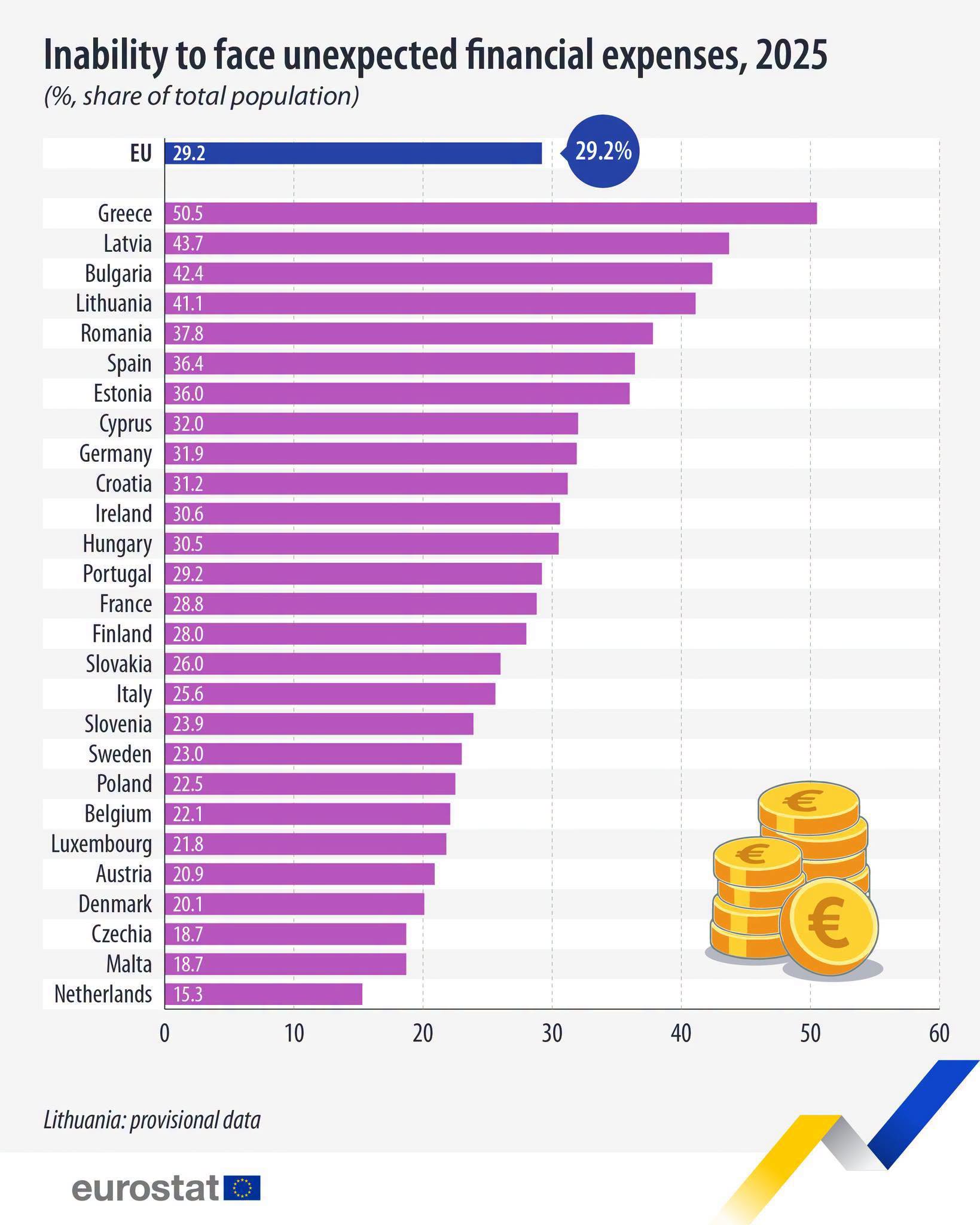
50.5% of Greeks cannot cover an unexpected expense using their own money. This is the highest percentage in the European Union and almost double the EU average of 29.2%, according to Eurostat data for 2025.
Greece in 2026 is recording primary budget surpluses and growing faster than the Eurozone average. The macroeconomic recovery is real. At the household level, however, the picture is different. Greece emerged from its bailout programmes with restored fiscal credibility, but without a financial safety net in the pockets of its citizens.
What Eurostat Measures and Why It Matters
The indicator comes from the EU-SILC survey on income and living conditions. It is one of the nine components of the material deprivation indicator and measures the enforced inability to cover an expense, rather than someone’s choice not to pay it.
Specifically, it examines whether a household can cover an unexpected expense using its own resources, without borrowing. The amount is approximately equal to the country’s monthly poverty threshold.
We are not talking about a family tragedy or a major disaster, but something much simpler and more common, such as a broken household appliance or an emergency visit to the dentist.
Across the EU, the percentage fell by 0.8 percentage points compared with 2024. However, significant differences remain between Member States.
Four countries exceed 40%. Greece leads by a considerable margin (50.5%), followed by Latvia (43.7%), Bulgaria (42.4%) and Lithuania (41.1%). At the other end of the spectrum are the Netherlands (15.3%), Czechia and Malta (18.7%).
The most important finding is Greece’s position: almost seven percentage points above the next country and more than 21 percentage points above the EU average.
Why Greece Ranks First
Greece’s position is not a temporary phenomenon. It reflects a decade of economic adjustment, during which much of the burden fell on households’ disposable income.
Four main factors explain most of the situation.
1. Savings Have Been Depleted
For much of the past 15 years, the household savings rate in Greece has been negative or close to zero. Many families maintained their consumption by spending savings accumulated in previous years.
Although total bank deposits have increased, their distribution remains unequal, with a relatively small proportion of accounts holding a large share of deposits.
2. Real Wages Have Not Fully Recovered
Nominal wage increases in recent years have been largely eroded by inflation between 2022 and 2024.
The purchasing power of the average employee remains below pre-crisis levels.
3. Housing Costs Consume a Large Share of Household Budgets
Greece consistently ranks among the EU countries with the highest housing cost burden.
In major cities, rents are under pressure from short-term rentals and limited housing supply, leaving households with very little room to build emergency savings.
4. Private Debt Remains a Burden
Debts owed to tax authorities, social security funds and loan servicers place ongoing pressure on future income.
A household repaying debt through a payment arrangement does not simply have less money available. It also has less flexibility to respond to an unexpected financial shock.
The result is a month-to-month financial model. Income is sufficient to cover current needs, but little or nothing remains for an emergency fund.
A new crisis will not necessarily resemble the one Greece experienced in 2010.
It is more likely to emerge from an external shock: energy market disruption, geopolitical escalation, recession among major trading partners or a downturn in tourism.
Whatever its origin, the ways in which such a crisis would affect Greek households are already familiar.
How Much Financial Pressure Can Greeks Withstand?
If one in two households cannot cover even a single unexpected expense, then for that part of the population, the ability to withstand a loss of income may be measured in weeks rather than months.
Financial planning advisers internationally recommend maintaining an emergency fund sufficient to cover three to six months of essential expenses.
Most Greek households remain far from this target.
However, financial resilience in Greece does not depend solely on bank balances.
Three informal safety nets played an important role during the previous crisis. They may provide support again, although their effectiveness is likely to be weaker.
- Family Support: Intergenerational solidarity provided one of the strongest forms of social protection during 2010–2020, as parents’ pensions often supported children and grandchildren. Today, many of those who provided that support are older and have fewer resources available.
- Homeownership: Greece’s relatively high homeownership rate protects many households from rental expenses. However, property is not liquid cash and cannot directly pay an electricity bill.
- The Informal Economy: Informal employment may provide short-term income, but it leaves workers without adequate social protection precisely when they need it most.
What Needs to Be Done Before the Next Crisis
Financial resilience must be built before a crisis begins, not after it has already unfolded.
Action is needed at three levels.
Households
Setting aside even a small but consistent amount each month in a separate savings account can make the difference between having to borrow and being able to cope independently.
Priority should also be given to repaying expensive consumer debt and entering available repayment arrangements before outstanding obligations become overdue.
Businesses
Small and medium-sized enterprises should keep business cash reserves separate from personal finances and maintain adequate liquidity.
While economic conditions remain favourable, businesses should also take advantage of development programmes and financing opportunities to strengthen their balance sheets.
Government
Budget surpluses create fiscal flexibility that should be directed towards measures capable of permanently increasing disposable income.
Such measures include reducing taxes on employment income, increasing the supply of affordable housing and introducing financial education in schools.
Temporary subsidies may offer relief, but they do not create lasting financial reserves.
Greece has restored discipline to its public finances, but the finances of its households have not yet achieved the same stability.
Eurostat’s figure of 50.5% is a warning that macroeconomic stability does not automatically translate into financial security for citizens.
The next economic crisis will come. Whether we experience it as a difficult year or another lost decade will depend on the decisions we make today, while conditions remain relatively stable.
Source: Eurostat

StartUpBusiness
Send Us a Message
Fill in your details and we will get back to you as soon as possible.